IPv6: Difference between revisions
Jump to navigation
Jump to search
New page: == Useful or Interesting Links == * [http://bgp.he.net/ipv6-progress-report.cgi Global IPv6 Deployment Progress Report] * [http://ipv6gate.sixxs.net/ SixXS IPv6 to IPv4 and IPv4 to IPv6 W... |
|||
| (34 intermediate revisions by 4 users not shown) | |||
| Line 1: | Line 1: | ||
== Address Space == | |||
[http://www.denis.lemire.name/media/IPv6%20Address%20Space.pdf http://www.denis.lemire.name/images/wiki/ipv6-address-space.png] | |||
=== Allocation and Assignments === | |||
Minimum direct allocation is currently /32. | |||
ISP assignments are as follows: | |||
* /64 when it is known that one and only one subnet is needed. | |||
* /56 for small sites, those expected to need only a few subnets over the next 5 years. | |||
* /48 for larger sites | |||
=== Addresses Space Size === | |||
* 340,282,366,920,938,463,463,374,607,431,768,211,456 unique IPs | |||
* 42,535,295,865,117,307,932,921,825,928,971,026,432 IPs in '''2000::/3''' (1/8<sup>th</sup> of total address space) | |||
* 1,208,925,819,614,629,174,706,176 IPs in a '''/48''' | |||
* 536,870,912 '''/32''' prefixes within '''2000::/3''' | |||
* 65,536 '''/48''' prefixes with a '''/32''' | |||
* 65,536 '''/64''' subnets within a '''/48''' | |||
* 35,184,372,088,832 '''/48''' prefixes within '''2000::/3''' | |||
* 8,192 IPv6 '''/48''' prefixes for every IPv4 address in '''2000::/3''' alone. | |||
* 18,446,744,073,709,551,616 IPs within a '''/64''' subnet | |||
=== Special Prefixes === | |||
* ::/8 | |||
** ::/128 - Unspecified | |||
** ::1/128 - loopback (IPv4 127/8 equivalent) | |||
** ::ffff:0:0/96 - IPv4 mapped addresses | |||
* 2000::/3 - IANA Global Unicast | |||
** 2001::/32 - Teredo (RFC-4380) | |||
** 2001:10::/28 - Orchid (RFC-4843) | |||
** 2002::/16 - 6to4 | |||
* FC00::/7 - unique local addresses | |||
** FC00::/8 is to be managed by a so-called "ULA-Central" for assigned /48s. As of 9-2007, this body has yet to be formed. | |||
** FD00::/8 is allocated by appending a randomly-generated 40-bit string, to derive a valid /48. RFC4193 offers a suggestion on how to do the random generation, to try to guarantee a minimum-quality result if the user does not have access to a good source of random numbers. | |||
* FE80::/10 - link-local addresses (169.254/16 equivalent) | |||
* FECO::/10 - site-local (deprecated) | |||
* FF00::/8 - multicast | |||
The remaining prefixes are all reserved for future Unicast allocations. | |||
=== Multicast Addresses === | |||
Multicast addresses exist within the '''FF00::/8'' prefix. | |||
* '''FF02::1''' - all v6 hosts on local subnet (IPv4 equivalent 224.0.0.1) | |||
* '''FF02::2''' - all v6 routers on local subnet (IPv4 equivalent 224.0.0.2) | |||
== Protocol Translation Mechanisms == | |||
* ''faithd'' can be used to translate on a per service basis. | |||
* ''ptrtd'' is a similar and better solution, but only appears to run on Linux at this time. | |||
* ''NAT-PT'' is also an option but it has been deprecated. | |||
* Using one of the above, ''totd'' is still required to translate DNS. | |||
== MAC to EUI64 == | |||
A MAC address is 48 bit wide, but we need a 64bit host ID in EUI64 format. The transformation is actually quite easy: | |||
# take the MAC of the network device (eg. 00:e0:81:2e:b6:d1) | |||
# flip bit 2 of the first byte (02:e0:81:2e:b6:d1) | |||
# insert FFFE in the middle (02:e0:81:FF:FE:2e:b6:d1) | |||
# combine with the network prefix into an IPv6 address (fe80::2e0:81FF:FE2e:b6d1) | |||
== Useful or Interesting Links == | == Useful or Interesting Links == | ||
* [https://6to4.nro.net/ IPv6 6to4 Reverse DNS Delegation - The Number Resource Organization] | |||
* [http://bgp.he.net/ipv6-progress-report.cgi Global IPv6 Deployment Progress Report] | * [http://bgp.he.net/ipv6-progress-report.cgi Global IPv6 Deployment Progress Report] | ||
* [http://ipv6gate.sixxs.net/ SixXS IPv6 to IPv4 and IPv4 to IPv6 Website Gateway] | * [http://ipv6gate.sixxs.net/ SixXS IPv6 to IPv4 and IPv4 to IPv6 Website Gateway] | ||
| Line 6: | Line 77: | ||
* [http://www.kame.net/~suz/gen-ula.html Generate Unique Local Address] | * [http://www.kame.net/~suz/gen-ula.html Generate Unique Local Address] | ||
* [http://www.potaroo.net/tools/ipv4/ IPv4 Address Report] | * [http://www.potaroo.net/tools/ipv4/ IPv4 Address Report] | ||
* [http://www.kame.net/~suz/freebsd-ipv6-config-guide.txt IPv6 configuration guide for FreeBSD users] | |||
== History == | |||
{| | |||
! Date !! Relevance | |||
|- | |||
| Mar 1996 || 6bone started | |||
|- | |||
|Jan 1, 2004 || 6bone prefix allocations halted. | |||
|- | |||
|Jul 20, 2004 || Experimented with Freenet6 and Hurricane Electric tunnels | |||
|- | |||
|Jun 6, 2006 || 6bone prefix phased out (3FFE::/16) | |||
|- | |||
|Oct 15, 2007 || IPv6 6to4 setup | |||
|- | |||
|Dec 17, 2007 || Tera-Byte prefix (2610:78:ad::/48) | |||
|- | |||
|Feb 4, 2008 || IPv6 records added to DNS root | |||
|- | |||
|July 9, 2008 || GoDaddy adds support for IPv6 glue for .com/.net TLDs | |||
|- | |||
|Mar 12, 2008 || Google Accessible via IPv6! | |||
|- | |||
|Jan 19, 2009 || Added IPv6 glue for my name servers (inferno,frosty) | |||
|- | |||
|Feb 3, 2011 || Final five IANA /8 blocks distributed to regional registries. | |||
|- | |||
|Feb 7, 2011 || ThinkTel prefix (2610:1e8:800:100::/56) | |||
|- | |||
|June 2, 2011 || New cable modem is DOCSIS 3, theoretically IPv6 ready. | |||
|- | |||
|June 8, 2011 || World IPv6 day | |||
|- | |||
|June 6, 2012 || World IPv6 Launch | |||
|- | |||
|April 23, 2014 || ARIN Enters Phase Four of the IPv4 Countdown Plan - Final /8 | |||
|- | |||
|Sep 24, 2015 || ARIN IPv4 space is exhausted. Rejoice! | |||
|- | |||
|Feb 8, 2016 || The long, long wait is over. My home has native IPv6 via Telus! | |||
|- | |||
|Jan 31, 2017 || I'll get my own damn prefix (2602:ff0d::/36), with blackjack and hookers! | |||
|} | |||
Latest revision as of 07:23, 2 February 2017
Address Space
[edit]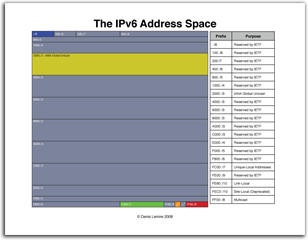
Allocation and Assignments
[edit]Minimum direct allocation is currently /32.
ISP assignments are as follows:
- /64 when it is known that one and only one subnet is needed.
- /56 for small sites, those expected to need only a few subnets over the next 5 years.
- /48 for larger sites
Addresses Space Size
[edit]- 340,282,366,920,938,463,463,374,607,431,768,211,456 unique IPs
- 42,535,295,865,117,307,932,921,825,928,971,026,432 IPs in 2000::/3 (1/8th of total address space)
- 1,208,925,819,614,629,174,706,176 IPs in a /48
- 536,870,912 /32 prefixes within 2000::/3
- 65,536 /48 prefixes with a /32
- 65,536 /64 subnets within a /48
- 35,184,372,088,832 /48 prefixes within 2000::/3
- 8,192 IPv6 /48 prefixes for every IPv4 address in 2000::/3 alone.
- 18,446,744,073,709,551,616 IPs within a /64 subnet
Special Prefixes
[edit]- ::/8
- ::/128 - Unspecified
- ::1/128 - loopback (IPv4 127/8 equivalent)
- ::ffff:0:0/96 - IPv4 mapped addresses
- 2000::/3 - IANA Global Unicast
- 2001::/32 - Teredo (RFC-4380)
- 2001:10::/28 - Orchid (RFC-4843)
- 2002::/16 - 6to4
- FC00::/7 - unique local addresses
- FC00::/8 is to be managed by a so-called "ULA-Central" for assigned /48s. As of 9-2007, this body has yet to be formed.
- FD00::/8 is allocated by appending a randomly-generated 40-bit string, to derive a valid /48. RFC4193 offers a suggestion on how to do the random generation, to try to guarantee a minimum-quality result if the user does not have access to a good source of random numbers.
- FE80::/10 - link-local addresses (169.254/16 equivalent)
- FECO::/10 - site-local (deprecated)
- FF00::/8 - multicast
The remaining prefixes are all reserved for future Unicast allocations.
Multicast Addresses
[edit]Multicast addresses exist within the 'FF00::/8 prefix.
- FF02::1 - all v6 hosts on local subnet (IPv4 equivalent 224.0.0.1)
- FF02::2 - all v6 routers on local subnet (IPv4 equivalent 224.0.0.2)
Protocol Translation Mechanisms
[edit]- faithd can be used to translate on a per service basis.
- ptrtd is a similar and better solution, but only appears to run on Linux at this time.
- NAT-PT is also an option but it has been deprecated.
- Using one of the above, totd is still required to translate DNS.
MAC to EUI64
[edit]A MAC address is 48 bit wide, but we need a 64bit host ID in EUI64 format. The transformation is actually quite easy:
- take the MAC of the network device (eg. 00:e0:81:2e:b6:d1)
- flip bit 2 of the first byte (02:e0:81:2e:b6:d1)
- insert FFFE in the middle (02:e0:81:FF:FE:2e:b6:d1)
- combine with the network prefix into an IPv6 address (fe80::2e0:81FF:FE2e:b6d1)
Useful or Interesting Links
[edit]- IPv6 6to4 Reverse DNS Delegation - The Number Resource Organization
- Global IPv6 Deployment Progress Report
- SixXS IPv6 to IPv4 and IPv4 to IPv6 Website Gateway
- IPv6: An Interview with Itojun
- Generate Unique Local Address
- IPv4 Address Report
- IPv6 configuration guide for FreeBSD users
History
[edit]| Date | Relevance |
|---|---|
| Mar 1996 | 6bone started |
| Jan 1, 2004 | 6bone prefix allocations halted. |
| Jul 20, 2004 | Experimented with Freenet6 and Hurricane Electric tunnels |
| Jun 6, 2006 | 6bone prefix phased out (3FFE::/16) |
| Oct 15, 2007 | IPv6 6to4 setup |
| Dec 17, 2007 | Tera-Byte prefix (2610:78:ad::/48) |
| Feb 4, 2008 | IPv6 records added to DNS root |
| July 9, 2008 | GoDaddy adds support for IPv6 glue for .com/.net TLDs |
| Mar 12, 2008 | Google Accessible via IPv6! |
| Jan 19, 2009 | Added IPv6 glue for my name servers (inferno,frosty) |
| Feb 3, 2011 | Final five IANA /8 blocks distributed to regional registries. |
| Feb 7, 2011 | ThinkTel prefix (2610:1e8:800:100::/56) |
| June 2, 2011 | New cable modem is DOCSIS 3, theoretically IPv6 ready. |
| June 8, 2011 | World IPv6 day |
| June 6, 2012 | World IPv6 Launch |
| April 23, 2014 | ARIN Enters Phase Four of the IPv4 Countdown Plan - Final /8 |
| Sep 24, 2015 | ARIN IPv4 space is exhausted. Rejoice! |
| Feb 8, 2016 | The long, long wait is over. My home has native IPv6 via Telus! |
| Jan 31, 2017 | I'll get my own damn prefix (2602:ff0d::/36), with blackjack and hookers! |